Comparable Cars
Overview :: > Specs
Bodystyles: Sedan, Hybrid
Classes: Hybrid Sedan, Compact
Engine: 1.4l 4-cyl. (150hp)
EPA Mileage:
[mpg]
na (City)
na (Highway)
Our Rating:not rated
All-new hybrid with plug-in capability

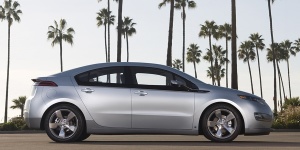
The Volt is what Chevrolet considers its answer to the challenges of the 21st century. Going head-to-head with other dedicated hybrids like the Toyota Prius and Honda Insight, the Chevy Volt delivers up to 40 miles of gasoline- and emissions-free electric driving. Extended range is provided by a 1.4-liter 4-cylinder engine.

Production of the Chevy Volt is scheduled to begin in late 2010.


Form follows function

The design of the Chevrolet Volt production car has evolved from the original concept that was unveiled at the 2007 North American International Auto Show in Detroit.

Because aerodynamics play a key role in maximizing driving range, GM designers created an aerodynamically efficient design for the production vehicle. Many of the design cues from the concept vehicle endure in the production Volt, including the closed front grille, athletic stance, rear design graphics, outside rear-view mirrors, and more. The Volt's rounded and flush front fascia, tapered corners and grille are functional, enabling air to move easily around the car. In the rear, sharp edges and a carefully designed spoiler allow the air to flow off and away quickly. An aggressive rake on the windshield and back glass help reduce turbulence and drag.

Working closely with GM aerodynamicists to shape the Volt, design and engineering teams developed one of the most aerodynamic vehicles in GM's history. They spent hundreds of hours with the Chevrolet Volt in the wind tunnel, testing and re-testing parts such as the front and rear quarter panels, rear spoiler, rockers, and side mirrors.

Inside, the Volt offers the space, comfort, convenience, and safety features that customers expect in a four-passenger sedan, and it delivers them in a variety of interior color, lighting, and trim options unlike any offered before on a Chevrolet sedan. Modern controls and attractive materials, two informational displays, and a touch-sensitive infotainment center with integrated shifter distinguish the Volt's interior from other vehicles in the Chevy line-up.


Technology

The Volt uses electricity to move the wheels at all times and speeds. For trips up to 40 miles, the Volt is powered only by electricity stored in its 16-kWh, lithium-ion battery. When the battery's energy is depleted, a gasoline/E85-powered engine generator seamlessly provides electricity to power the Volt's electric drive unit while simultaneously sustaining the charge of the battery.

The Chevrolet Volt can be plugged either into a standard household 120v outlet or use 240v for charging. The vehicle's intelligent charging technology enables the Volt's battery to be charged in less than three hours on a 240v outlet or about eight hours on a 120v outlet. Charge times are reduced, if the battery has not been fully depleted. Charging the Volt about once daily will consume less electric energy annually than the average home's refrigerator and freezer units.

More than 220 lithium-ion cells contained within the Volt's battery pack provide ample power. The Volt's electric drive unit delivers the equivalent of 150 horsepower, 273 lb-ft. (370 Nm) of instant torque, and a top speed of 100 miles per hour.

GM estimates that the Volt will cost about two cents per mile to drive while under battery power compared to 12 cents per mile using gasoline priced at $3.60 per gallon. For an average driver who drives 40 miles per day (or 15,000 miles per year), this amounts to a cost savings of $1,500 annually. Using peak electric rates, GM estimates that an electrically driven mile in a Chevy Volt will be about one-sixth of the cost of a conventional gasoline-powered vehicle. The cost savings are even greater when charging during off-peak hours, when electric rates are cheaper.

Search
Sponsored Links