Comparable Cars
Exterior :: > Specs
More Content: Overview - Lineup - Interior - Handling - Verdict

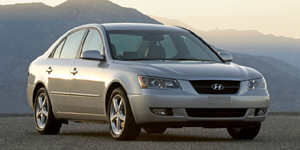
Design tastes are extremely volatile in the automotive world. A styling cue like an arched-eyebrow headlight treatment can go from eye-catching to invisible in a couple years. Or it can survive for decades and come to be accepted as a brand trademark, such as BMW's twin-kidney grille. The Hyundai Sonata hasn't yet found its signature trademark cues, but the 2006's designers are looking in the right places.

The new Sonata's fascia is refreshingly clean and spare, with sharply angled headlight housings and a quiet, clean-cut grille topped with a sliver of chrome. Wide and deep openings beneath the front bumper provide a home for tightly focused foglamps and visually pull the front end closer to the ground while directing cooling air into the radiator. The striking, concave hood reduces the car's perceived mass without cramping the engine compartment.

The side treatment avoids the all-too-common wedge look with an almost horizontal beltline riding above softly shouldered fenders and door panels. Mirrored "Z" seams where the end corners of the bumpers meet the quarter panels add interest, while blacked-out window surrounds play down the tallish side glass. Extended C-pillars shorten the deck lid, which itself presents a rounded, gently sculpted profile vaguely reminiscent of the much maligned posterior posture of today's BMW sedans. The flat-flanged rims on the up-level 17-inch wheels suggest a high-end European import more than an affordable Asian nameplate.

The taillight outlines repeat the headlight shapes and bookend a broad, trapezoidal license plate inset. Again, there's a hint of other cars' architecture, most notably contemporary Camrys and Accords. Sporty, California hot-rod-idiom dual exhausts mark the V6-equipped models.

Interior ::
More Content: Overview - Lineup - Exterior - Handling - Verdict

The 2006 Hyundai Sonata's interior marks a major step up the quality ladder. Some rough edges on a few plastic molds and a less-than-lustrous finish on some dash panels are the only shortcomings we noticed. The overall look, though, is clearly competitive with most in the class and better than some.

A polished, hard-surfaced applique capped with a thin slice of chrome divides the upper and lower halves of the dash. The upper is a glare-absorbing dark color, the lower a space-enhancing light tone. The passenger airbag enclosure is seamless, mimicking the trend in higher-end midsize sedans.

As with many modern cars, the stereo head is fully integrated into the dash, making difficult any aftermarket customizing of the sound system, but adding an upscale touch. Air conditioner controls are mounted beneath the stereo, within the accent trim centered in the lower portion of the center stack. Stereo and air conditioner controls are substantial, finger-friendly, intuitive knobs and buttons, with status and selections clearly displayed in their respective LCD screens.

Three round dials in the hooded instrument cluster communicate the bare necessities of operational data to the driver, with the largest the speedometer nestled inside a polished circle. To its left is the tachometer, to its right conjoined water temperature and fuel gauges. In the lower dash to the left of the steering column are a bank of five switch plugs, only two of which are employed in the U.S. version, one as an on/off for the ESC, the other the dash-light rheostat, and a flip-down storage bin. The ignition key slides into a slot placed where it should be, in the dash to the right of the steering column instead of on the steering column itself.

All models get a leather-wrapped steering-wheel. On the GLS and LX, the steering wheel serves multiple duties. Besides the obvious, redundant controls for the audio (arrayed somewhat oddly, with the mode selector on top and the volume controlled by the lower two, versus the more common approach of sandwiching the mode button between the volume controls) are appended to the lower left-side of the hub. On the other side of the hub are the cruise controls, with a helpful Cancel function.

Outward visibility is good, although the wide C-pillars constrict quick, over-the-shoulder traffic checks for lane changing. Rear side windows roll all the way down, thanks to small, fixed, rear quarter windows that move the windows' rear tracks forward in the door. All four doors have roof-mounted, hinged assist handles.

Seats are comfortable, with adequate bolstering for the style of driving to which the Sonata aspires. The cloth upholstery on the GL looks and feels durable; on the GLS, it's a bit fancier in texture and stitching. The leather surfaces in the LX add a touch of class without pretending to be luxurious. The height adjustment on the driver's seat, both manual and power, pivots on the seat's front mounts, which effectively moves the seat forward as it rises. This compels taller drivers to choose between rearward seat travel and forward sightline, not always a happy compromise. On the upside, this adds inches to rear-seat legroom behind the driver, one of the multitude of measures in which the 2006 HyundaiSonata bests the competition. Among the primary competitors, the new Sonata only comes in second to the Honda Accord in front and rear headroom and to the Toyota Camry in rear-seat headroom, but by a mere one- to three-tenths of an inch. And of the second-tier competitors, the Kia Optima alone betters the new Sonata and then only by three-tenths of an inch in front seat hip room.

Rear seats are accommodating, with the bottom cushion in the center position only minimally higher than and nearly as well padded as the outboard positions. Both rear outboard seating positions have adjustable head restraints, as do the front seats. The rear seatback is split 60/40 and folds to allow the transport of long objects, such as skis and snowboards or gardening tools, depending on the weekend and season.

Storage bins and cubbies are about average for the class. Only front doors have map pockets, and there's no compartment in the rear of the center console, which is, however, bi-level and on the LX fitted with a sliding top cover. The center console and the rear-seat center armrest provide two cupholders each. A small bin in the forward part of the center console is convenient for coins and keys, while a fuzzy-finished cubby with a flip-down cover occupies the space in the center stack below the climate control panel. A thoughtful addition is a flip-out hook in the footwell on the passenger side of the center stack to restrain handbags and the like.

The trunk is the second most capacious in the class, losing out to the Toyota Camry by less than half a cubic foot. Despite the use of gas-pressure struts (which the hood has, too, an upscale touch not all of the competition offer) and articulated linkage on the trunk lid, the Sonata's stubby back end constrains the opening; in other words, it holds a lot, just not big lots.

Find a pre-owned 2006 Sonata:
« previous page 1 | 2 | 3 next page »
Search
Sponsored Links
