Comparable Cars
Exterior :: > Specs & Features
More Content: Overview - Lineup - Interior - Handling - Verdict

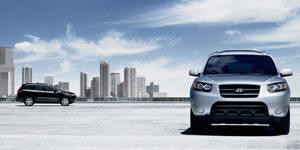
Compared to the previous-generation model (2006 and earlier), which was polarizing with its undulating lines, the new Hyundai Santa Fe blends in with other SUV/crossovers in its segment.

With its relatively long wheelbase and short overhangs, Hyundai says the Santa Fe now evokes the assertive grace of a speed skater. Certainly it has more the profile of a sporty station wagon than that of a traditional body-on-frame SUV. Some would say it looks like a smaller version of the Volkswagen Touareg, which is not a bad comparison.

The most noticeable attribute of the Santa Fe's front end is the complete absence of a bumper. Instead the front valence curves around from beneath the body to encompass the large grille and wrap around headlights. The hood slopes up toward the raked windshield, and the wedge shape continues along the lower edges of the side windows that sweep up dramatically toward the tailgate.

Even the rear has distinctively curved lines, with high taillight clusters that are partially mounted on the main body and the tailgate. The easy to see and easy to grab tailgate handle is definitely a Hyundai Santa Fe design cue.

Although the current Santa Fe is slightly larger than the previous model, it looks smaller because its styling is more refined and less truck-like.

Interior :: > Safety & Features
More Content: Overview - Lineup - Exterior - Handling - Verdict

Pleasing is the best way to describe the interior of the Hyundai Santa Fe because it's trimmed in modern plastics with a soft-touch feel. All models feature blue accent lighting at night to illuminate the instruments, switches and the edges of the front cupholders. Even the base GLS has nice luxury touches that include realistic-looking (but faux) wood-trim accents across the width of the dashboard, surrounding the shifter, and along the door panels.

The gauges are mounted in a large instrument pod in front of the steering wheel. The radio and climate controls are well located in a center stack that is mounted high in the dashboard for easy reach and observation while driving.

New for 2008, the navigation system was developed exclusively for Hyundai by LG, a leading worldwide electronics manufacturer. The system provides coverage for the continental United States and includes touch-screen functionality, point-of-interest features, and audio-visual prompts.

According to Hyundai's measurements, headroom and legroom in the Santa Fe is greater in all rows than in competing models, thanks to a uniquely designed unibody that is not based off an existing car platform. That allowed the engineers to maximize interior space without compromise.

With the optional third row of seats folded down, there is a generous 34.2 cubic feet of storage space on an almost flat floor. Fold down the middle row of seats and there is 78.2 cubic feet of storage space. Although the Santa Fe is one of smallest midsize SUVs in exterior dimensions it is far from being the smallest inside, a tribute to its space-efficient design.

The air vents for the center row of seats are mounted in the B-pillar, which is much more effective than being mounted down low behind the center console, as in many vehicles.

Third-row seating in the Santa Fe is similar to that in other SUVs, so it's of limited use for anything other than carrying kids short distances. Setting up the third row for seating in the Santa Fe leaves a mere 10 cubic feet of cargo space, which is no more than you'll find in a cramped two-door coupe. If you really need to carry seven passengers and/or cargo, a minivan is better. Additionally, one loses the very practical hidden storage space under the rear floor when the vehicle is fitted with the optional third row of seats. In short, the Hyundai Santa Fe can carry seven passengers but works better for five.

« previous page 1 | 2 | 3 next page »
Search
Advertising
