Comparable Cars
Overview :: > Specs & Features
MSRP: $21,245 - $27,245 > Request a Quote
Bodystyle: SUV
Class: Compact SUV
Engine: 2.4l 4-cyl. (166hp)
EPA Mileage:
[mpg]
20 (City)
26 - 27 (Highway)
Our Rating:
More Content: Lineup - Exterior - Interior - Handling - Verdict
High-dollar crossover style in a compact-price SUV.

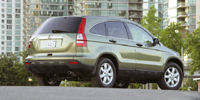
Once funky and cute, the Honda CR-V has grown up to look more like a high-dollar crossover. This latest-generation CR-V, completely redesigned and re-engineered for the 2007 model year, is more powerful and more comfortable than the previous-generation models. Its new suspension geometry delivers an improved ride and better, more responsive handling. The four-cylinder engine employs variable intake valve timing to optimize horsepower and torque for acceleration and cruising speeds and it's paired with a five-speed automatic transmission.

Compared with the previous-generation Honda CR-V, there's slightly more room in the front seat and (in most dimensions) slightly less room in the rear. There's marginally more cargo room. Everything by way of instruments, controls and storage is, respectively, logically arrayed, properly placed, and reasonably plentiful. Buyers can choose from three models: the basic LX, mid-range EX, or leather-upholstered EX-L, which can be fitted with an optional navigation system that incorporates a rear-view video camera for safe and easy backing. All have four doors and seat five.

Real Time all-wheel drive is offered on all three models. The 2009 fuel economy figures from the U.S. government's EPA rate the front-wheel-drive CR-V at 20/27 miles per gallon City/Highway, and the all-wheel-drive version at 20/26 mpg.

For 2009, Honda has introduced three new colors: Crystal Black Pearl, Alabaster Silver Metallic, and Urban Titanium Metallic.

Model Lineup :: > Specs & Features
More Content: Overview - Exterior - Interior - Handling - Verdict

All Honda CR-V models come with a 166-hp four-cylinder engine and a a five-speed automatic transmission. Front-wheel drive is standard, four-wheel drive is available for all models ($1,200).

The Honda CR-V LX ($21,245) comes with fabric upholstery, air conditioning, cruise control, powered outside mirrors that fold, power windows, power central locking, driver's-seat height adjustment, 60/40-split rear seatbacks that recline and fold, tilt-and-telescope steering wheel, four-speaker AM/FM/CD/MP3/WMA stereo, trip computer/information center, a collapsible tray between the front seats, and 17-inch steel wheels with P225/65R17 tires.

The CR-V EX ($23,495) adds a tilt-and-slide power moonroof; intermittent rear window wiper/washer; steering wheel-mounted audio controls for a six-speaker stereo with an in-dash, six-CD changer; dual-deck cargo shelf; lights-and-horn security system; rear privacy glass; and an outside ambient temperature gauge.

The CR-V EX-L ($26,045) features leather-trimmed seats, armrests, shifter, and steering wheel; heated front seats; dual-zone automatic climate control; eight-way power-adjustable driver's seat with power lumbar support; a 270-watt, seven-speaker (including subwoofer) premium stereo; XM satellite radio with a 90-day trial subscription; and a front center console with storage for 24 CDs.

The Honda CR-V EX-L can also be equipped with voice-recognition GPS-based navigation, and a rear-view camera. The CD changer then moves into what was the CD storage space in the console.

No other options are offered, although Honda-approved accessories available from dealers include wheel locks; attachments/racks for bicycles, kayak, skis, and surfboard; a roof box; auto-dim inside mirror with compass; amplified bass speaker system; and backup sensors.

Safety features that come standard include the required three-point seatbelts at all five seating positions; child safety seat anchors (LATCH); front airbags; front seat-mounted side airbags (to minimize upper body injuries in side impacts); roof-mounted, front and rear seat side air curtains (to minimize head injuries in side impacts and rollovers); and front-seat active head restraints (to minimize neck injuries in rear impacts).

For crash avoidance there are anti-lock brakes (which let the driver steer during panic stops); electronic brake-force distribution (which optimizes braking power front-to-rear during emergency stops); brake-assist (which senses impending emergency brake application and boosts pedal pressure); Vehicle Stability Assist (Honda's electronic stability control system that attempts to minimize skidding in turns); and tire pressure monitors (which warn of dangerous drops in tire pressure).

1 | 2 | 3 next page »
Search
Sponsored Links
