3.0l 6-cyl. (210)
3.3l 6-cyl. (225hp)
The Toyota Camry is the ultimate transportation appliance. It's a safe buy, a good vehicle to recommend to your friends. It pleases many buyers by offending none. It is in many ways an unremarkable car. What's remarkable about it is its lack of identifiable flaws. It does not have the personality of, say, a , but it's much more refined. It will transport its occupants from A to B and back without any drama, nor any worries about reliability, year in and year out. It's comfortable, smooth and quiet. Its controls are very easy to operate. You never have to try to figure out how to work something.
.jpg "Picture of 2004 Toyota Camry XLE")
.jpg "Picture of 2004 Toyota Camry SE")
.jpg "Picture of 2004 Toyota Camry LE")
.jpg "Picture of 2004 Toyota Camry LE")
.jpg "Picture of 2004 Toyota Camry LE")
.jpg "Picture of 2004 Toyota Camry SE")
.jpg "Picture of 2004 Toyota Camry XLE")
.jpg "Picture of 2004 Toyota Camry SE")
.jpg "Picture of 2004 Toyota Camry LE")
.jpg "Picture of 2004 Toyota Camry SE")
.jpg "Picture of 2004 Toyota Camry SE")
.jpg "Picture of 2004 Toyota Camry SE")
The 2004 Toyota Camry is available in 3 versions:
| Sedan | Coupe | Convertible |
The 2004 Toyota Camry Sedan is powered by a base 2.4-liter Inline-4 with 157 hp. Other available engines include a 3.0-liter V6 with 210 hp and a 3.3-liter V6 with 225 hp.
|
||
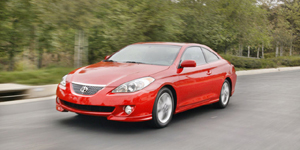
The 2004 Toyota Camry Coupe is powered by a base 2.4-liter Inline-4 with 157 hp. Also available is a 3.3-liter V6 with 225 hp.
|
||
The 2004 Toyota Camry Convertible is powered by a 3.3-liter V6 with 225 hp.
|
||
