Ride & Handling :: > Specs
More Content: Overview - Lineup - Exterior - Interior - Verdict

The old Ford Mustang, a modified, stiffened, and welded version of the 1979 Fox platform, was about as stiff as wet rope, but this new all-steel Mustang body and chassis unit is a claimed 31 percent stiffer than the recently departed SN95 Mustang, which should improve ride quality, noise, and handling.

It doesn't look it, but the new Mustang has a wheelbase that is a full six inches longer than the outgoing model, and that makes all the difference. The ride has smoothed out, and the remaining harshness is of a completely different order. The new rear suspension uses coil springs and a lightweight three-link design with a Panhard bar and other locators to keep things constant.

The new 4.0-liter V6 engine has more technical sophistication than any previous Ford V6. It is a very solid performer in urban, exurban, and suburban duties, and the ratios in the automatic seem well matched to the available torque. When the automatic transmission gets into overdrive fifth gear, the engine goes quietly into economy mode until called upon for a lane change, a pass, or an uphill charge. But it's still a large-displacement V6 and it sounds more muscular at full throttle than any previous Ford V6 engine.

The V6 Deluxe is the most popular model; Ford says that for every three GTs sold, it will sell seven of the V6 versions. At this low price, we were particularly impressed with its power, torque, acceleration, and general road manners, including its pretty, rorty exhaust note. Interestingly, while it has 90 horsepower and 80 foot-pounds less grunt than the V-8 and rides on smaller tires, the V-6 seems slightly more eager to turn and more agile than the nose-heavy GT V-8 (the GT weighs about 150 pounds more, and almost all of it is on the front tires).

The Mustang is relatively heavy, and the brakes are a whopping 15 percent larger than the old brakes; they really work well in high-speed highway driving situations, as we found out on our test drive in Los Angeles. If you want ABS, you will automatically get, and pay for, traction control, which has a dash-mounted off switch for special situations, like racing, for instance.

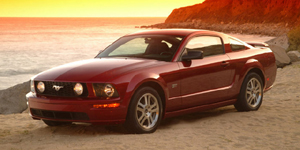
The Ford Mustang GT is a 300-horsepower, five-speed pavement-ripper for about $25,000. The new three-valve V8 engine features both variable camshaft timing and electronic throttle control, with a new set of smarter, faster-acting engine electronic controls. It will run 0-60 mph in about 5 seconds, it will outbrake a large number of sporty cars with its big new brakes, and it handles better on canyon roads that any previous Mustang except the Cobra, with a minimum of body roll and a large portion of tire grip.

It looks mean, and it drives mean, with 320 pound-feet of torque, a slick shifter, a brawny, loud exhaust note, and one of the world's largest aftermarket networks, including Ford's in-house parts company, Ford Racing Technology, for those who want even higher performance.

Verdict :: > Specs
More Content: Overview - Lineup - Exterior - Interior - Handling

The Ford Mustang has been so popular for so long that, over time, it simply blew the old Barracuda, the Challenger, the Camaro, the Firebird, and the AMC AMX and Javelin pretenders right off the street. It started the ponycar genre, and now, after 40 years of street and track competition, it's the only one left.

There is nothing else that says modern American sporty car better than this new Mustang. Its combination of high style, performance, and handling with a light touch can't be beat for this kind of money, and early indications are that the quality should be far better than any previous Mustang. Ford is planning on building about 175,000 of these a year, and we think they're shooting low. Way low.

by Jim McCraw Our Rating:
Find a pre-owned 2005 Mustang:
« previous page 1 | 2 | 3
Search
Sponsored Links
